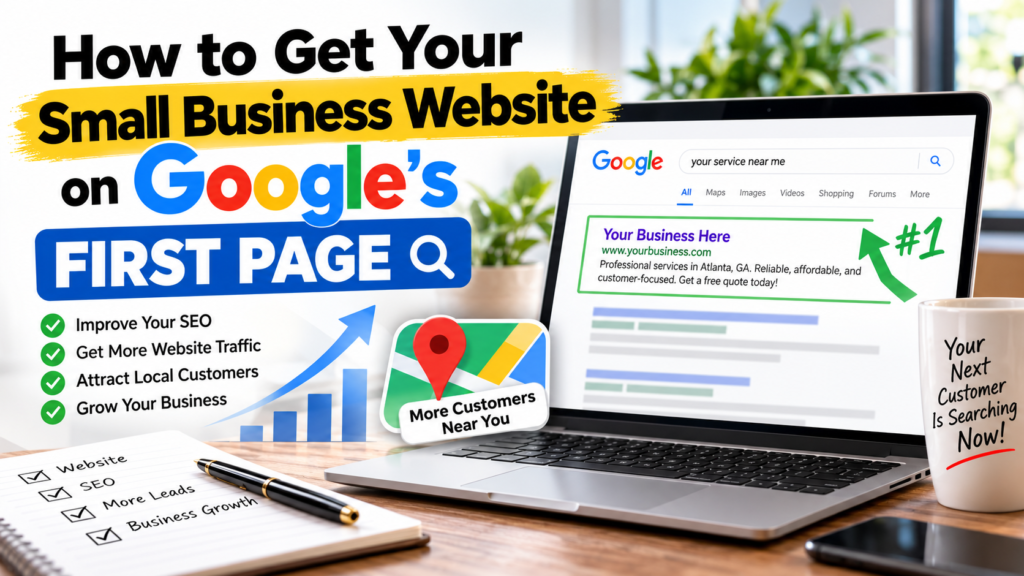
How to Get Your Small Business Website on Google's First Page
Imagine a potential customer searching Google for the exact products or services your business provides. They’re ready to hire someone, request a quote, or make a purchase.
They type a search such as “plumber near me,” “cleaning company in Atlanta,” or “website designer Atlanta GA.”
Within seconds, Google displays businesses competing for their attention.
Here’s the important question: Is your business appearing where those customers can find you?
How would you feel if more potential customers discovered your business online, visited your website, and contacted you instead of your competitors?
That’s what an effective search engine optimization (SEO) strategy can help you work toward.
At Ricka Websites and Logos, we help small business owners build professional, SEO-ready websites designed to improve online visibility, build trust, and encourage customers to take action.
In this guide, you’ll discover practical steps to improve your website’s Google rankings, attract relevant visitors, and turn more of those visitors into potential customers.
1. Understand How Google Ranks Small Business Websites
Before trying to reach Google’s first page, it’s important to understand how search engines discover and evaluate websites.
Google uses automated systems to crawl webpages, understand their content, and determine which results may best answer a user’s search.
Search rankings depend on many factors, including:
How relevant your content is to the search.
Whether your website provides useful, trustworthy information.
How easily Google can discover and understand your pages.
The quality of your website’s user experience.
Signals that help establish your business’s reputation and authority.
For local searches, Google also considers factors such as relevance, distance, and prominence.
According to Google Search Central, effective SEO starts with making your content useful, understandable, and accessible.
Remember: Nobody can legitimately guarantee the number-one organic position on Google. However, consistent improvements can help your website compete for more relevant searches.
2. Target Keywords Your Customers Actually Search
Imagine spending hours creating website content that nobody searches for.
You might have a beautiful website, but without the right keywords, potential customers may struggle to discover your services.
That’s why keyword research is an important part of small business SEO.
Keywords are the words and phrases people enter into Google when searching for information, products, or services.
Examples of valuable local keywords
For a plumbing company:
Plumber in Atlanta GA
Emergency plumbing services Atlanta
Water heater repair Douglasville
Licensed plumber near me
For a cleaning company:
House cleaning services Atlanta
Office cleaning company Marietta
Move-out cleaning Douglasville
Residential cleaning services near me
For a website design company:
Website designer Atlanta GA
Affordable website design for small business
WordPress website designer
Small business website design Atlanta
How to choose the right keywords
Start by identifying the services you offer and the locations you serve.
Then ask yourself:
What would someone type into Google if they were ready to hire my business today?
Use tools such as Google Keyword Planner and Google Search Console to discover keyword opportunities.
Focus on keywords that match your services and customer intent rather than simply chasing the highest search volume.
3. Optimize Your Website Pages for SEO
Choosing keywords is only the beginning.
Your website must also help Google understand what each page is about.
This process is called on-page SEO.
Write clear SEO titles
Your page title should accurately describe the content and naturally include your main keyword.
For example:
Weak title: Welcome to Our Website
Better title: Professional Plumbing Services in Atlanta, GA
The second title communicates both the service and location.
Create compelling meta descriptions
A meta description summarizes your webpage and may be used in search results.
Example:
“Looking for reliable plumbing services in Atlanta? We provide drain cleaning, leak repairs, and water heater services. Call today for an estimate.”
Although meta descriptions aren’t a direct Google ranking factor, helpful descriptions can encourage relevant users to click when Google displays them.
Use descriptive headings
Organize your content using a clear heading structure:
H1: Main page title.
H2: Important sections and services.
H3: Supporting details and frequently asked questions.
Avoid repeating keywords unnaturally. Instead, explain your services clearly and answer customers’ questions.
Optimize your images
Use descriptive image filenames and useful alternative text.
For example:
Filename: atlanta-plumbing-water-heater-repair.webp
Alt text: “Plumber repairing a residential water heater in Atlanta.”
Only use descriptions that accurately match the image.
If your website needs better structure, faster loading, or improved navigation, professional website design services can help establish a stronger SEO foundation.
4. Create Helpful Content That Answers Customer Questions
Imagine your ideal customer searching for a solution to a problem.
Instead of immediately finding a sales pitch, they discover a helpful article explaining exactly what they need to know.
That article answers their questions, demonstrates expertise, and introduces your business as a possible solution.
That’s one of the benefits of blogging.
Blog topics that attract potential customers
A roofing company could publish:
How Much Does Roof Repair Cost in Atlanta?
7 Signs Your Roof Needs Professional Attention
Roof Repair vs. Roof Replacement: Which Is Better?
A landscaping company could publish:
Best Landscaping Ideas for Atlanta Homes
How Much Does Lawn Maintenance Cost in Georgia?
When Should You Hire a Professional Landscaper?
A website design company could publish:
How Much Does a Small Business Website Cost?
WordPress vs. Wix for Small Business Websites
How to Get More Customer Calls From Your Website
Each article should provide useful information, original examples, and clear answers.
Quality matters more than publishing volume. A detailed, genuinely helpful article can provide more value than several repetitive posts written only to target keywords.
For more website design and online marketing insights, explore the Ricka Websites and Logos articles.
5. Improve Your Local SEO and Google Business Profile
If your business serves customers in Atlanta, Douglasville, Marietta, Smyrna, Lithia Springs, or surrounding communities, local SEO should be a priority.
Local SEO helps businesses improve visibility for geographically relevant searches.
For example, someone searching “electrician in Douglasville” is likely looking for a nearby service provider.
Optimize your Google Business Profile
Your Google Business Profile can help customers discover your business through Google Search and Maps.
To improve your profile:
Claim and verify your business if eligible.
Select the most accurate business category.
Add complete and accurate business information.
Keep your business hours updated.
Upload authentic photos of your business or work.
Encourage genuine customer reviews.
Respond professionally to reviews.
Link to your official business website.
Google explains that local rankings are mainly influenced by relevance, distance, and prominence.
Read Google’s official local ranking recommendations.
Create useful location-specific website content
If your company serves multiple cities, consider creating dedicated service-area pages when you can provide genuinely useful, distinct information.
For example:
Website Design in Atlanta
Website Design in Douglasville
Website Design in Smyrna
Website Design in Marietta
These pages should explain the services available, customer needs, relevant projects, and what makes your business helpful in each area.
Avoid creating dozens of nearly identical city pages simply to manipulate search rankings.
Think about it: When someone searches for a service in their own city, a page that clearly addresses their local needs may be more useful than a generic homepage.
6. Make Your Website Mobile-Friendly and Fast
How would you feel if a potential customer found your website on Google, clicked your listing, and left because the page took too long to load?
You could lose an opportunity before the visitor even sees your services.
A professional small business website should provide a smooth experience across smartphones, tablets, and computers.
Important website improvements
Mobile-friendly design: Make sure text, images, navigation menus, and buttons display properly on smaller screens.
Fast loading: Compress images, use efficient hosting, and remove unnecessary scripts or plugins.
Simple navigation: Help visitors find services, contact details, pricing information, and important pages.
Secure browsing: Use HTTPS to protect website connections.
Clear calls to action: Make it easy for customers to call, request a quote, or book an appointment.
You can test your website using Google PageSpeed Insights.
A fast website doesn’t guarantee first-page rankings, but improving performance can create a better experience for both visitors and search engines.
7. Build Internal Links Between Relevant Website Pages
Internal linking is one of the most overlooked opportunities in small business SEO.
An internal link connects one page of your website to another page on the same domain.
For example, a blog about small business SEO could link to a website design service page, a relevant local service page, or another helpful article.
Why internal linking matters
Internal links can:
Help Google discover additional pages.
Explain relationships between related content.
Help visitors navigate your website.
Guide potential customers toward your services.
Reduce the likelihood of important pages becoming isolated.
Google recommends making important pages accessible through links from other pages on your website.
Internal linking example
Imagine someone reading an article about improving their Google rankings.
They discover that their website is outdated, difficult to navigate, and poorly optimized.
A natural next step would be exploring Ricka Websites and Logos for professional website design assistance.
The key is to use descriptive, relevant link text rather than adding links randomly.
8. Earn Quality Backlinks From Relevant Websites
Backlinks are links from other websites pointing to yours.
They can help search engines discover your content and contribute to your website’s online reputation.
However, not all backlinks provide equal value.
A relevant link from a respected industry publication, local business organization, or genuine partner can be more useful than numerous links from unrelated, low-quality websites.
Ways to earn legitimate backlinks
Contribute original insights to relevant industry publications.
Join reputable local business organizations.
Publish useful resources that other websites may reference.
Collaborate with complementary businesses.
Share original research, guides, or case studies.
Participate in relevant community initiatives.
For example, an Atlanta landscaping business might publish a detailed seasonal lawn-care guide that local homeowners or community websites find useful.
Avoid buying links intended to manipulate rankings, participating in automated link schemes, or publishing low-value guest posts solely to obtain backlinks.
Focus on earning links because your content deserves to be referenced.
9. Use Google Search Console to Monitor Your Progress
Imagine knowing exactly which Google searches are bringing visitors to your website.
You could identify your strongest pages, discover new keyword opportunities, and understand where improvements are needed.
That’s where Google Search Console becomes valuable.
This free tool helps website owners monitor their visibility in Google Search.
Important metrics to track
Impressions: How often your website appeared in eligible search results.
Clicks: How many times people clicked through to your website.
Click-through rate (CTR): The percentage of impressions that resulted in clicks.
Average position: The average ranking position across the searches and appearances included in the report.
Indexing status: Whether Google has indexed specific pages and any reported indexing issues.
How to find SEO opportunities
Open Search Console and review the Performance report.
Look for keywords where your pages receive impressions but relatively few clicks.
Then investigate whether the page:
Matches what searchers want.
Has an accurate, compelling title.
Provides enough helpful information.
Answers important customer questions.
Includes relevant internal links.
Also inspect important URLs to identify crawling or indexing issues.
Submitting a sitemap and requesting indexing can help Google discover your pages, but neither guarantees indexing or first-page rankings.
10. Turn Google Visitors Into Paying Customers
Getting your website onto Google’s first page is an exciting goal.
But what happens after someone clicks?
Imagine receiving more website visitors but very few phone calls or inquiries.
Your website might be attracting attention without helping customers take the next step.
That’s why search engine optimization and conversion-focused website design should work together.
Add strong calls to action
Instead of using generic phrases like “Learn More” everywhere, use action-oriented messages such as:
Call Today for a Free Consultation
Request Your Free Website Design Quote
Schedule Your Service Appointment
Get Started With a Professional Website
Speak With a Website Designer
Build trust throughout your website
Show potential customers why they should choose your business.
Include genuine customer reviews, clear service descriptions, authentic project photos, contact information, and an explanation of your process.
Make phone numbers easy to tap on mobile devices.
Keep contact forms short and straightforward.
Remember: The goal isn’t simply to appear on Google’s first page. It’s to help the right customers find your business, trust what they see, and feel confident contacting you.
11. How Long Does It Take to Reach Google’s First Page?
One of the most common questions business owners ask is:
“How long will it take my website to rank on Google?”
The answer depends on several factors, including:
Competition for your target keywords.
Your website’s current SEO condition.
The quality and usefulness of your content.
Your business’s online reputation.
Technical and indexing issues.
How established your website is.
Some improvements may become visible relatively quickly, while competitive searches can require months or longer of consistent work.
There is no guaranteed timeline.
For a small business, targeting specific services and relevant local searches can be a more practical starting point than competing immediately for broad national keywords.
For example, a local cleaning company may find more relevant opportunities by focusing on “office cleaning services in Douglasville” than simply targeting “cleaning.”
The objective is to attract visitors who are actually interested in the services you provide.
Frequently Asked Questions About Google First-Page Rankings
Can I get my small business website on Google’s first page for free?
Yes. Organic search listings do not require payment for placement. You can improve your website through helpful content, technical SEO, keyword research, and legitimate link building. However, SEO may still require an investment of time, tools, or professional assistance.
Does having a website guarantee that my business will appear on Google?
No. Google must first discover and index eligible pages. Even indexed websites are not guaranteed to rank for every relevant search.
How many keywords should I target on each webpage?
Focus on one main search intent and include closely related terms naturally. There is no fixed number of keywords required to rank.
Do blog posts help small business SEO?
Yes. Helpful blog posts can attract visitors searching for information related to your services. They can also support internal linking and demonstrate relevant expertise.
Is WordPress good for small business SEO?
WordPress can be an excellent platform for small business websites because it supports customizable page titles, URLs, content organization, SEO plugins, and other optimization features. Results still depend on how the website is built and maintained.
Do Google reviews help local SEO?
Google identifies review count and positive ratings as factors that can contribute to local prominence. Reviews can also help potential customers evaluate your business.
Should I focus on SEO or Google Ads?
SEO can help build long-term organic visibility, while Google Ads can provide paid visibility for selected searches. Many businesses benefit from using both approaches when their budgets and goals support them.
Can I rank in multiple cities around Atlanta?
It’s possible to gain organic visibility for searches across multiple service areas. Create helpful content for locations you genuinely serve. Google Business Profile visibility also depends on factors such as distance, so rankings may vary by searcher’s location.
Final Thoughts: Start Building a Website That Works for Your Business
Imagine what could happen if more people searching for your services discovered your business, explored your website, and felt confident reaching out.
A stronger Google presence can create opportunities to attract customers who are already interested in what you offer.
But reaching Google’s first page requires more than adding keywords to a website.
It takes a combination of useful content, effective website design, technical optimization, local SEO, internal linking, and ongoing improvements.
The good news?
You don’t have to figure everything out on your own.
Ready to Improve Your Website’s Google Visibility?
At Ricka Websites and Logos, we help small businesses in Atlanta, Douglasville, Lithia Springs, Smyrna, Marietta, and throughout Metro Atlanta create professional websites designed to build credibility, improve search visibility, and generate more customer inquiries.
Whether you need a brand-new website, a WordPress redesign, or an SEO-ready online presence, we’re here to help.
Professional small business websites starting at just $150!
Imagine having a website that not only looks professional but also makes it easier for potential customers to discover your services and contact you.
Your next customer could be searching online right now. Make sure your business is ready to be found.
Visit Ricka Websites and Logos to Get Started
Professional Website Design | WordPress Websites | Small Business SEO | Metro Atlanta